 EN
EN

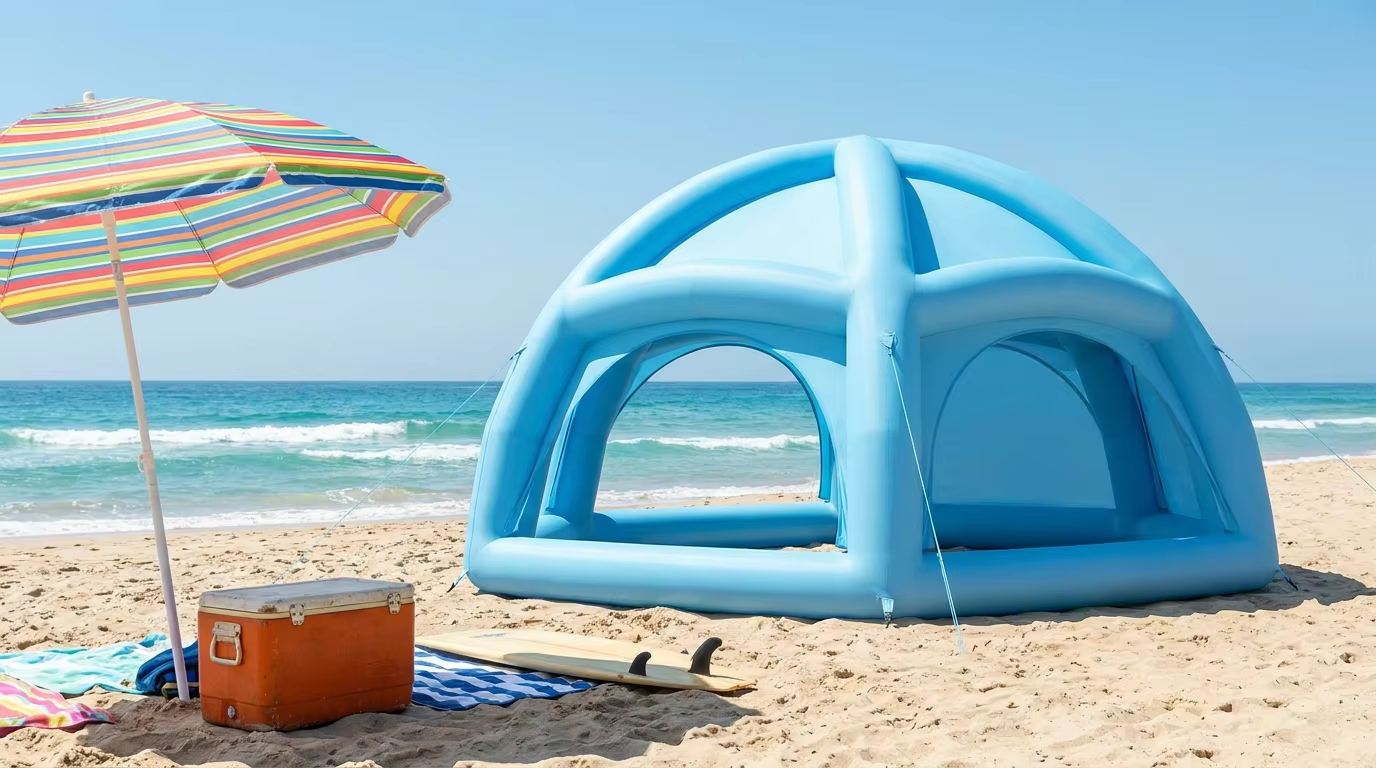
The Technology That Eliminates the Worst Part of Camping
Ask anyone what they dislike about tent camping, and setup ranks first or second every time. Threading poles through fabric sleeves, matching color-coded segments, and tensioning everything in fading daylight is the ritual that drains enthusiasm before the camping actually starts. An inflatable tent replaces every pole with an air beam — a pressurized tube that inflates in under two minutes with a manual pump and forms a rigid structural frame without a single aluminum or fiberglass segment.
The concept sounds like a gimmick until the physics become clear. Air beams under pressure behave differently from mechanical poles under bending stress, and those differences cascade through every aspect of tent performance: setup speed, wind response, packed size, and long-term durability.
How Air Beam Technology Actually Works
The TPU Bladder Inside the Polyester Sleeve
An air beam in an inflatable tent consists of a thermoplastic polyurethane (TPU) bladder enclosed in a protective polyester outer sleeve. The bladder holds air at 6-10 PSI — roughly the pressure of a soccer ball — distributed evenly along the entire beam length. The outer sleeve constrains the bladder's expansion, forcing the pressurized air to create structural rigidity rather than ballooning outward. When all beams in the frame are pressurized to the same level, the tent structure becomes a rigid air-frame that resists compression, bending, and torsion.
The key engineering detail is the one-way valve at each beam's inflation point. A silicone diaphragm inside the valve allows air in during pumping and seals instantly when pumping stops. Valve failure — the diaphragm sticking open or developing a micro-tear — is the single most common failure mode in inflatable tent systems. Higher-end designs use double-redundant valves with a screw-cap secondary seal.
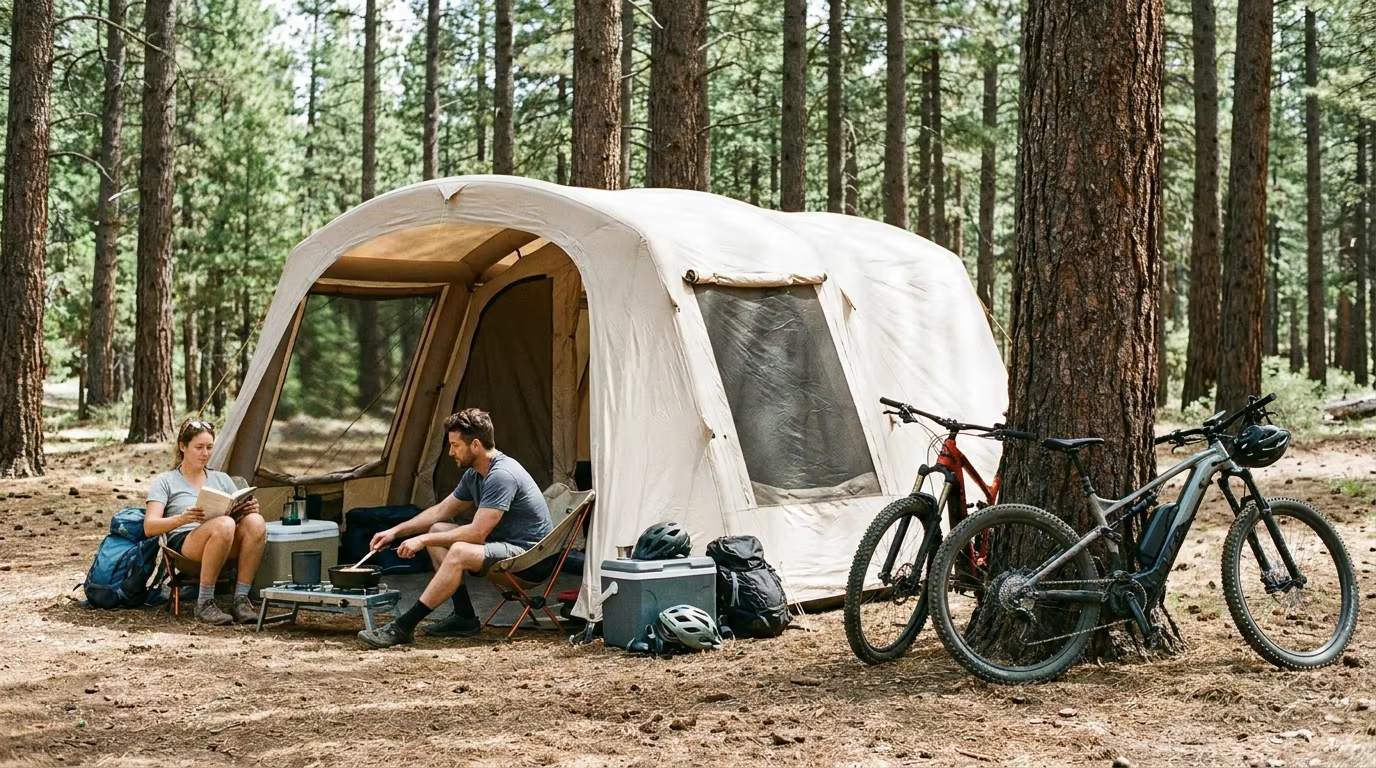
Why Air Beams Handle Wind Differently Than Poles
A traditional pole tent resists wind by transferring load through rigid aluminum or fiberglass segments to the ground via stakes and guy lines. When wind exceeds the pole's bending strength, the pole snaps — a sudden, catastrophic failure. An air beam in an inflatable tent responds to wind overload differently: it flexes under gust pressure and rebounds to its original shape when the gust passes. The air pressure acts as a continuous internal spring. The beam does not snap because there is no rigid material to fracture.
The practical limit is beam pressure loss. A beam that loses pressure below 4 PSI becomes too flexible to maintain frame geometry, and the tent partially collapses. This is a gradual failure mode rather than a sudden one — occupants typically notice the tent walls softening and have time to add air before the structure fails completely. For campers in exposed terrain where overnight storms are a realistic risk, this progressive failure mode is inherently safer than sudden pole breakage.
Setup Speed: The Measurable Advantage
A two-person traditional dome inflatable tent equivalent — a standard dome with two crossing poles — takes a practiced camper 6-8 minutes to pitch, including staking and rainfly attachment. The inflatable version of the same tent deploys in 90 seconds of pumping plus 3-4 minutes of staking. The difference is 2-3 minutes per setup, which sounds marginal until multiplied across a week-long trip with daily relocation, or across a commercial rental fleet with 20 units turning over three times per week.
For families with young children, the setup time advantage is amplified because child supervision and tent pitching cannot happen simultaneously. A inflatable tent that deploys while one adult pumps and the other watches the kids eliminates the forced choice between setup speed and child safety that traditional pole tents create.
The Durability Question: TPU vs. Pole Longevity
Traditional pole tents fail at segment joints — the stress concentration where one aluminum section inserts into another. An inflatable tent eliminates this failure mode entirely by having no joints. The cost is a different vulnerability: TPU bladders degrade over time through a process called hydrolysis, where water molecules in humid air break down the polyurethane molecular chains. A TPU bladder stored damp or in a high-humidity environment for extended periods loses elasticity and eventually develops micro-cracks that prevent holding pressure.
The practical lifespan comparison: a quality aluminum pole set used 30 nights per year lasts 5-7 years before individual segments need replacement due to ferrule wear. A TPU air beam used under the same conditions lasts 4-6 years before a bladder replacement. The difference narrows when considering that replacing a single pole segment often costs as much as replacing an entire TPU bladder — roughly $25-40 per beam.
A Real Commercial Deployment Case
A European festival camping equipment rental company servicing events with 500-1,000 tent deployments per season tested inflatable tent models alongside traditional pole tents across one full summer. The inflatable units reduced setup labor by 40% — a team of two could pitch and stake eight inflatable tents in the time required for five traditional pole tents. The trade-off appeared in maintenance: 7% of inflatable units required valve or bladder service after the season, compared to 3% of pole tents requiring segment replacement. The company's cost analysis showed that the labor savings from faster setup outweighed the higher maintenance rate by a factor of 2.3:1, driven primarily by reduced staffing hours during the compressed setup windows before each festival's opening day.
The company standardized on inflatable units for all deployments of 50 tents or fewer — where labor was the binding constraint — and retained pole tents for the largest events where maintenance throughput during turnaround days was the limiting factor.

Procurement Guidelines for Inflatable Tents
Test the Valve Before Committing to Volume
Order a single inflatable tent sample and inflate-deflate it through 20 complete cycles. Listen for changes in the valve sound during pumping — a valve that becomes progressively louder or develops a whistling noise indicates a diaphragm beginning to fail. After the 20th deflation, time how long the beams hold pressure with the valves capped: a beam that loses more than 1 PSI over 8 hours has a slow leak in either the valve or the bladder seam.
Evaluate the Pump System
The included pump is not an accessory — it is a critical component. A dual-action pump that moves air on both the up and down stroke inflates an inflatable tent roughly 40% faster than a single-action pump. Electric pumps with a preset PSI cutoff prevent over-inflation, which is the most common cause of bladder seam failure in first-time users who assume "more pressure equals more stiffness."
Check Bladder Access for Field Repair
When a TPU bladder fails in the field, the repair involves removing the bladder from its polyester sleeve, locating the leak, and applying a TPU-specific adhesive patch. On some inflatable tent designs, the bladder sleeve zips open along its full length for easy removal. On others, the bladder is sewn into the sleeve and requires seam-ripping to access. For commercial operations where field repairs are expected, full-zip bladder access is a non-negotiable specification.
Frequently Asked Questions
How long does it take to set up an inflatable tent?
A 4-person inflatable tent inflates in 60-90 seconds of manual pumping and requires an additional 3-4 minutes for staking and guy-line tensioning. Total solo setup time including rainfly attachment averages 6-8 minutes, compared to 10-14 minutes for an equivalent traditional pole tent.
Can an inflatable tent pop or burst?
An inflatable tent air beam operates at 6-10 PSI — comparable to a soccer ball. The TPU bladder inside a polyester sleeve can withstand pressures exceeding 20 PSI before rupture. Catastrophic bursting is extremely rare; gradual pressure loss from valve or seam leaks is the realistic failure mode.
How does an inflatable tent perform in strong wind?
Air beams flex under wind gust pressure and rebound to shape when the gust passes — a fundamentally different response than rigid poles that snap at their failure point. A properly staked inflatable tent handles sustained 25-30 mph winds and gusts to 40 mph, comparable to mid-range aluminum pole tents.
What maintenance does an inflatable tent require?
Store the inflatable tent completely dry to prevent TPU bladder hydrolysis. Inspect valves for debris before each inflation cycle. Test beam pressure retention annually by inflating to 8 PSI and checking pressure after 12 hours. Apply silicone lubricant to valve O-rings every season to prevent sticking.
How long do inflatable tent air beams last?
TPU bladders in an inflatable tent typically last 4-6 years with proper storage and seasonal use of 30 nights per year. The primary degradation mechanism is hydrolysis from moisture exposure during storage. Field-replaceable bladders extend overall tent life beyond the initial bladder lifespan.
Are inflatable tents heavier than traditional pole tents?
An inflatable tent typically weighs 5-15% more than an equivalent pole tent due to the TPU bladder mass. The packed volume is comparable because air beams collapse flat. The weight penalty decreases as tent size increases — for 6-person and larger family tents, the weight difference between inflatable and pole designs narrows to under 5%.